Arthroscopy is a minimally invasive surgical technique that orthopaedic surgeons use to diagnose and treat joint problems. The term comes from the Greek words “arthro” (joint) and “skopein” (to look), which literally means “to look inside the joint.”
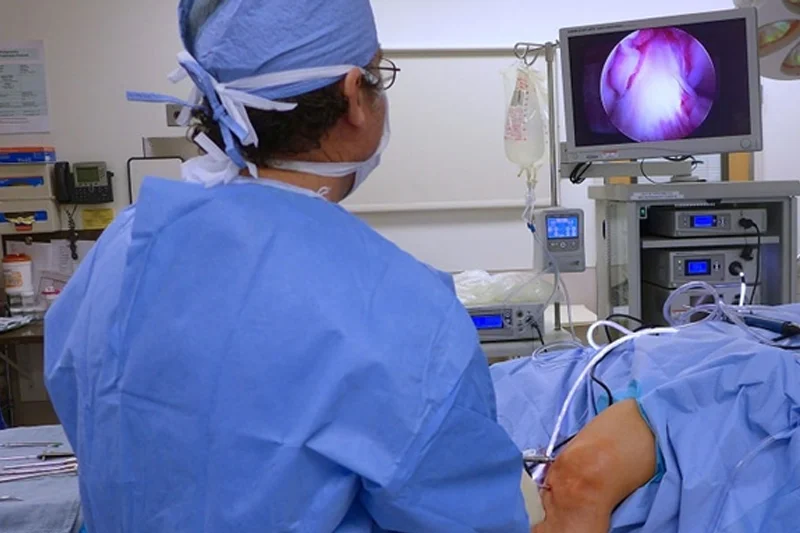
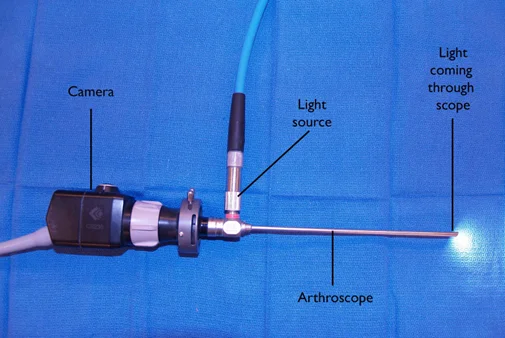
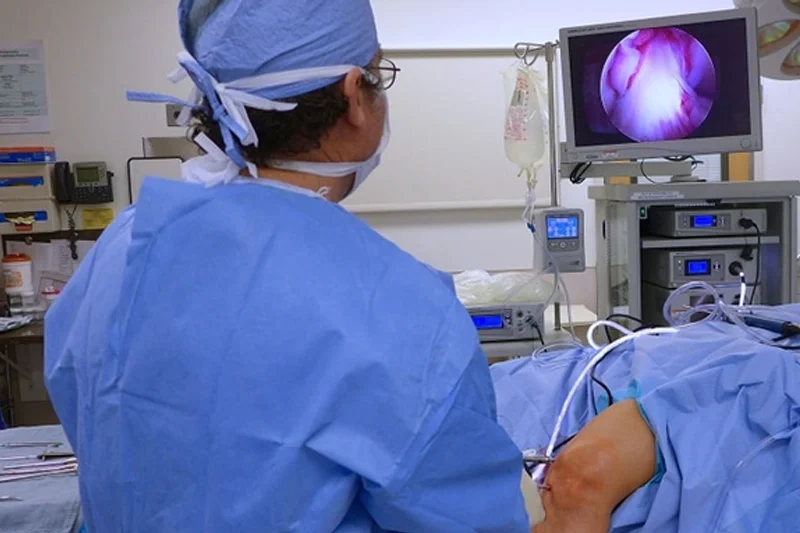
During the procedure, a small incision is made in the skin, and a pencil-sized instrument called an arthroscope—equipped with a lens, lighting system, and miniature camera—is inserted into the joint. The camera projects images onto a video monitor, allowing the surgeon to view the inside of the joint clearly. Unlike traditional open surgery, arthroscopy requires only small incisions, which generally leads to faster recovery and less post-operative discomfort.
Conditions Treated with Arthroscopy
Arthroscopic surgery is commonly used to treat:
Inflammation: e.g., Synovitis (inflammation of the tissue around the joint).
Acute and chronic injuries, including:
Rotator cuff tears
Shoulder impingement
Recurrent shoulder dislocation
Meniscus (cartilage) tears in the knee
Chondromalacia (cartilage damage in the knee)
ACL tears with instability in the knee
Carpal tunnel syndrome in the wrist
Loose fragments of bone or cartilage in the knee, shoulder, elbow, ankle, or wrist
Some conditions associated with arthritis can also be treated using arthroscopy.
Common Arthroscopic Procedures
Arthroscopy may be performed alone or in combination with open surgery. Common procedures include:
Rotator cuff repair
Repair or removal of torn cartilage (meniscus) in the knee or shoulder
ACL reconstruction in the knee
Removal of inflamed tissue (synovium) in various joints
Carpal tunnel release in the wrist
Ligament repair
Removal of loose bone or cartilage fragments
How Arthroscopy Is Performed
Arthroscopy is carried out in a hospital or surgical suite under general, spinal, or local anesthesia, depending on the joint involved.
A small incision (about the size of a buttonhole) is made to insert the arthroscope.
Additional tiny incisions may be made to introduce surgical instruments.
Specialized tools are used to repair or correct the problem inside the joint.
Originally, arthroscopy was used only as a diagnostic tool, but with advances in surgical technology, it is now widely used to both diagnose and treat many joint conditions.
After surgery, the small incisions are covered with a dressing. Patients typically recover quickly and often require little or no pain medication.
Recovery After Arthroscopy
The tiny puncture wounds usually heal within a few days.
Dressings are often removed the day after surgery, with adhesive strips applied to the healing incisions.
Although pain is usually minimal, it can take several weeks for the joint to fully recover.
A customized rehabilitation plan may be recommended to speed healing and protect joint function.
Many patients return to work, school, or daily activities within a few days, while athletes and physically active individuals may return to sports within a few weeks.
Recovery times vary depending on the patient’s diagnosis, overall health, and the extent of the procedure.
Advantages of Arthroscopy
Smaller incisions compared to open surgery
Less pain and quicker recovery
Outpatient procedure — most patients go home the same day
Widely used and highly effective for both athletes and non-athletes alike
testimonials
our happy client
Lorem ipsum dolor sit amet, consectetur adipiscing elit, sed do eiusmod tempor incididunt ut labore et dolore magna aliqua. Ut enim ad minim veniam.
Raisa BarkerPatient
Lorem ipsum dolor sit amet, consectetur adipiscing elit, do ut labore magna aliqua.
Terrence BakerPatient
Lorem ipsum dolor sit amet, consectetur adipiscing elit, do ut labore magna aliqua.
Xiong LeePatient
Lorem ipsum dolor sit amet, consectetur adipiscing elit, do ut labore magna aliqua.